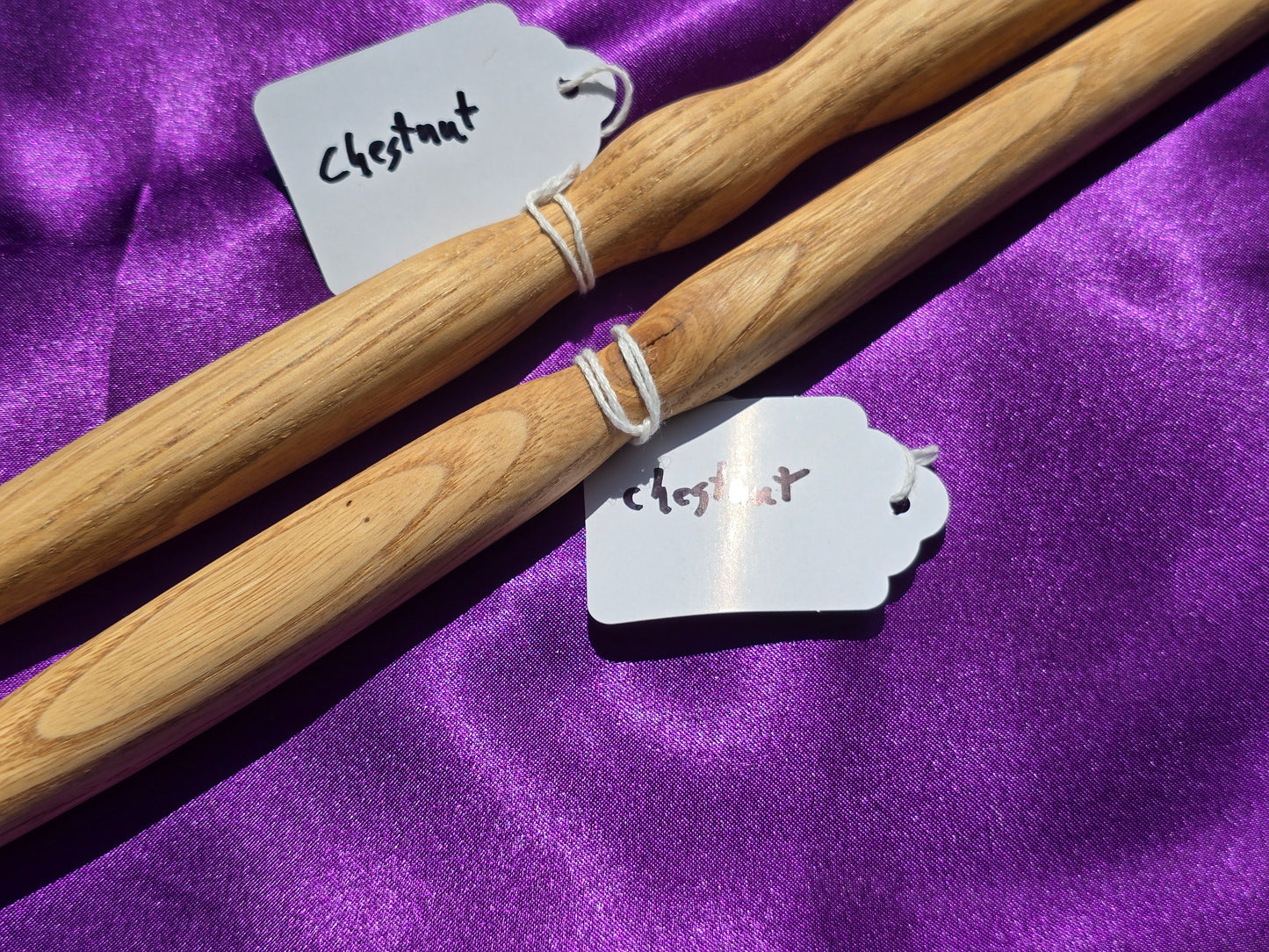
Chestnut Traditional Length Wand
Chestnut Traditional Length Wand
Listing is for one wand, we will send the one you pick if it is still available.
Chestnut should always be approached with gratitude. It’s a tree of quiet strength and long memory, its offerings are generous, but never to be taken lightly. It was once considered bad luck to burn chestnut wood hastily or without offering thanks, it needed a slow, and respectful fire.
Chestnuts belong to the Fagaceae family of trees, which include beech and oak. All three are generous providers of life-sustaining gifts. Sweet chestnuts can live to be more than 2,000 years old, and is native to Europe and Asia Minor. The American chestnut is still a critically endangered tree. Unfortunately, 3–4 billion American chestnut trees were destroyed by chestnut blight between 1900 and 1950. The blight-resistant Japanese and Chinese chestnut, Castanea mollissima, are now the most commonly planted species in the United States. Sweet chestnuts are beginning to be planted as a commercial crop. This serves as a reminder that all providers must take care of themselves if they are to provide for others. Chestnut, through serious conservation efforts, is beginning to make a comeback and with them, hope and abundance.
Native Americans may have used chestnut leaves to treat severe coughs and heart disease, a poultice of the leaves for sores and a decoction of the bark to treat worms. Herbalists use Chestnut to help rid the body of toxins.
Alexander the Great and the Roman army planted sweet chestnut trees across Europe to insure a staple food source for their troops. In Japan the chestnut fruit symbolizes both difficulties and overcoming them. They are eaten on New Year’s Day for success and strength the coming year. American chestnuts were staples in the diets of native people for thousands of years, where they blanketed eastern North America. The chestnut was nicknamed the "acorn of Zeus" by the Greeks, and was considered a sacred gift. For the Celts chestnut was considered the guardian of humans and animals at the end of each year. Its bare, gnarled roots make it a symbol of new lifegiving energy. In Druidic and British folk traditions, chestnut was linked to solar energy, the harvest cycle, and enduring generosity In Italy and southern France, entire villages once relied on chestnut harvests to survive the cold months, earning it the title l’albero del pane, the “bread tree.”
Associated with the fire element and masculine energy, it is often linked to enhancing creativity and fertility, and a symbol of life carried through darkness. Chestnut groves were often planted near sacred springs or burial mounds, where the tree’s long life and abundant fruit symbolized rebirth and ancestral blessing. It was believed that carrying a chestnut in your pocket could ward off melancholy and misfortune, especially in the colder months. To place three chestnuts on the hearth was a charm to protect the household through winter. Dreaming of chestnut burrs foretold either a prickly truth or a delayed reward, depending on whether you were pricked or fed in the dream. In some folk customs, a woman seeking fertility would sleep with a roasted chestnut beneath her pillow on the first full moon after Samhain. One old word for horse chestnut is “conker” and are used for the enhancement of “male nature”, to protect from rheumatism, for gambling success and work-related issues. Chestnut tree can be given as a birth gift to celebrate the arrival of new life.
With its ability to regrow from old stumps and its history of surviving blight, the chestnut represents overcoming adversity, longevity, and rebirth. Its immense lifespan is seen as a bridge to ancestral wisdom and a witness to history. Chestnut is thought to act as a bold remedy that helps break through mental blockages, shadows, and deep-seated fears. The spiritual energy of the chestnut is that of a reliable provider. It symbolizes nourishment, nurturing the mind, body, and soul. Balance: Connecting heaven and earth, often representing a balance between destiny and action. Honesty: A straightforward "truthful" wood that does not require adornment. Chestnut signals a time of taking on the responsibility of being a provider for ourselves, our family and our community. Chestnut is considered highly grounding, helping to calm anxiety, ease turbulent energy, and bring mental clarity. Chestnut harmonises the flow of energy and helps to ease anxiety caused by contrast and difference. Very grounding, it helps to promote clarity of mind and intuition and encourages inner peace.
Chestnut signals a time when we are being asked to be a trustworthy and reliable provider from start to finish. This is also a time of paying attention to our own needs if we are to help others. We may need to pay closer attention to details to complete our tasks, no matter how mundane it may seem. True providers offer stability and kindness during difficult times that nourish the mind, body and soul.
Staves made from chestnut wood are said to encourage longevity, increase energy, enhance intuition and help with grounding and centering of energy. Chestnut wood can also be used to make talismans for justice, success, to gain the sympathy of your audience and to encourage your mind to take in information.
Wands or staves made from chestnut are believed to increase personal energy and enhance intuition, and can aid to banish negativity and cleanse the home. Chestnut wood is also used to craft talismans for justice, truth, and protection from negativity.
And Chestnut, Chestnut brings us hope.
Couldn't load pickup availability
Low stock: 2 left
View full details